Assistant Professor of Political Science, Vrije Universiteit Amsterdam
Hi, thanks for stopping by! I am an Assistant Professor of Political Science at the Department of Political Science and Public Administration, VU Amsterdam. I work in comparative politics, political behaviour, political economy and political methodology.
My research examines how citizens and political institutions respond to economic, geopolitical and technological change, with a particular focus on European politics and multilevel governance. My substantive work spans public opinion and political behaviour; party and electoral politics; protest, social movements and political mobilisation; comparative political economy; European integration, security and solidarity; and the politics and governance of artificial intelligence. Methodologically, I use and develop a range of approaches, including experiments and causal inference, survey research, Bayesian statistics, time-series analysis, measurement, network analysis, formal modelling, and computational methods such as machine learning, text analysis and the auditing of large language models.
Learning Who Decides: Responsibility Attribution and Public Support for the EU
Chendi Wang, Hongyi She
Elements in European Politics, Cambridge University Press, under contract
Citizens credit both the EU and their governments with authority across policy areas; told who is in charge, they update beliefs and responsibility, but trust barely moves.
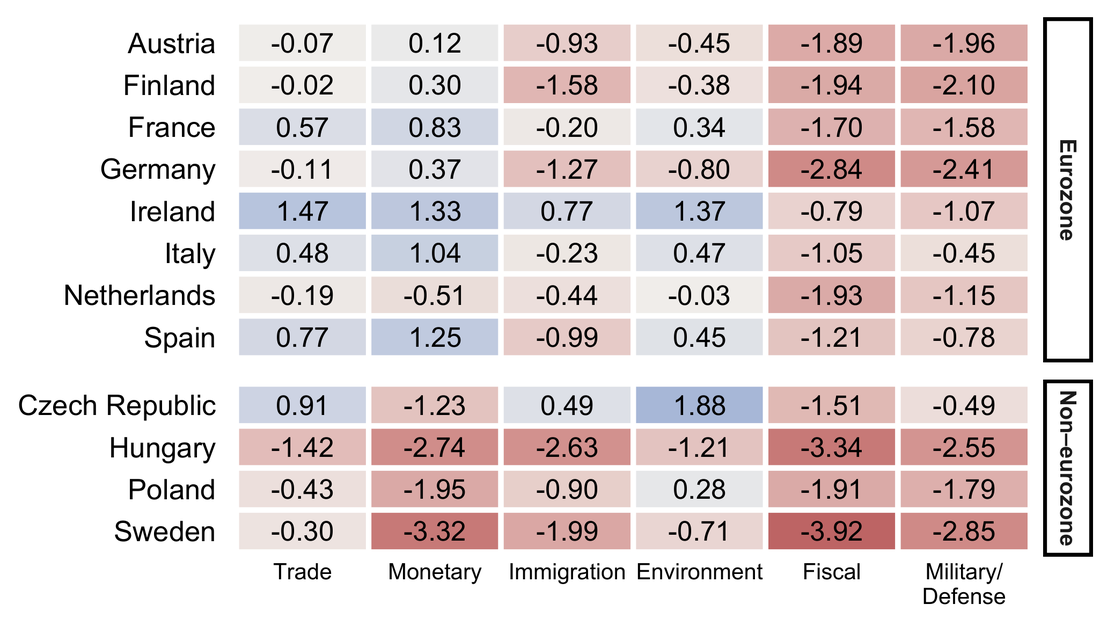
Who do Europeans think decides, and what changes when they learn? Drawing on an original survey of 24,684 respondents in twelve EU member states, this Element examines citizens’ authority maps, their beliefs about the division of authority between the EU and national governments. Across six policy domains, respondents attribute substantial authority to both levels despite differences in formal competence, with an overall tilt toward national governments. A randomized survey experiment shows that citizens learn from information about which level is in charge, shifting their beliefs about who decides toward that level, though only partly, with smaller updates among those least knowledgeable about the EU. Judgments of responsibility for current conditions follow, while trust, support for European integration and vote intentions barely move. Information can thus ease the EU’s accountability problems, but mainly by showing citizens whom to hold to account.
Whose Guarantee Counts, and for What? Overlapping Security Guarantees and the Form of Allied Assistance
Chendi Wang
Under review
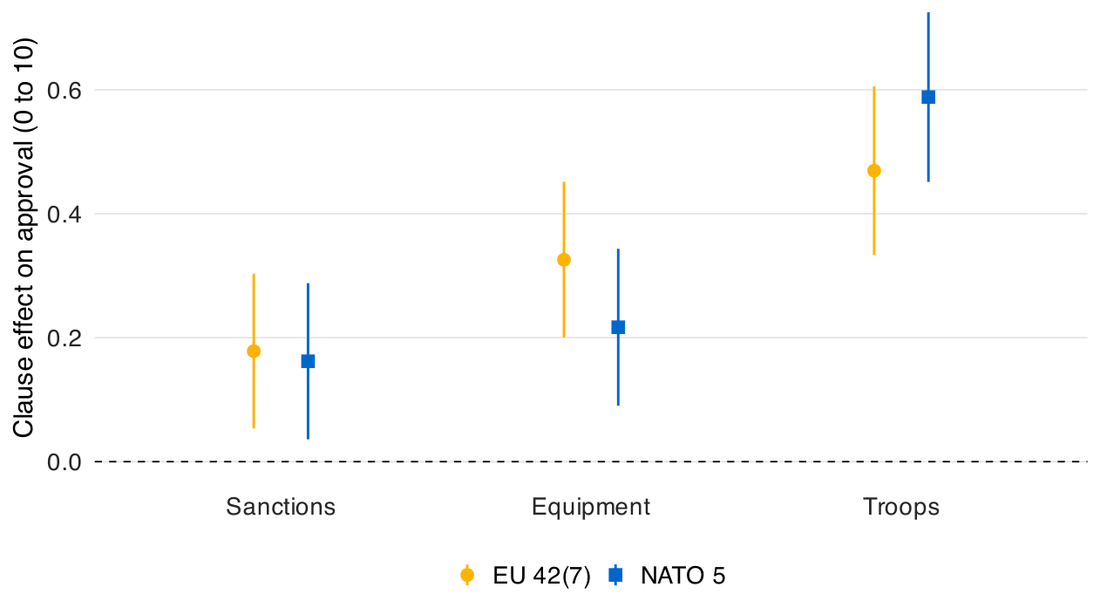
A twelve-country experiment: invoking NATO’s Article 5 or the EU’s Article 42(7) raises support for helping an attacked ally, and the NATO clause concentrates it on troops.
A mutual-defense commitment can establish a duty to help an ally without settling what help is required. I distinguish the force of an obligation, how strongly it binds, from its content, the contribution that discharges it. Two commitments can mobilize similar support for deploying troops yet differ in what suffices short of it, so deployment-only comparisons can conceal consequential differences. A preregistered experiment in twelve EU countries describes a Russian attack on Lithuania under NATO’s Article 5, the EU’s Article 42(7), or neither, crossed with four American stances. Each description raises approval of sanctions, equipment, and troops, without an established ranking between them. The NATO description concentrates mobilized support on troops more than the EU description, with positive estimates in every sampled member country. The two keep mobilizing support when the United States refuses to help, and an American offer of equipment alone lowers approval of national deployment.
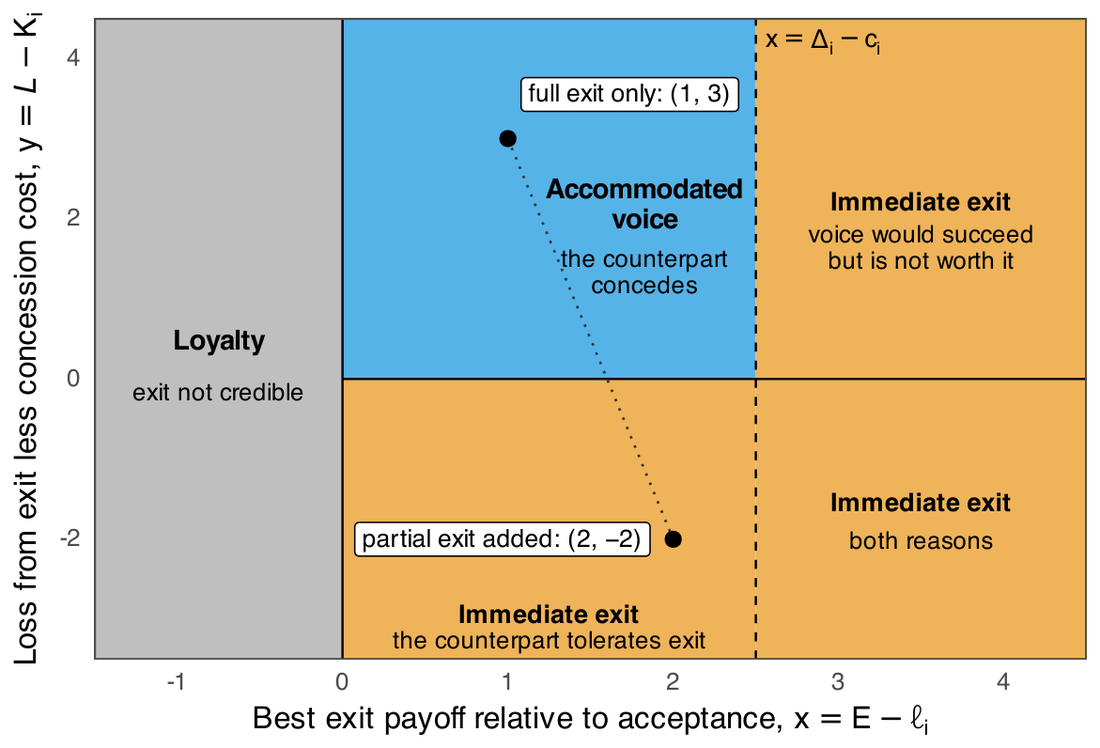
A formal model of governments that can refuse a common project in several ways: the exit they would choose sets their leverage, and accommodation need not benefit them.
A government can often refuse a collective undertaking in more than one way. It may leave the organization, stay out of one initiative, withhold a contribution or block one legal route. I extend exit, voice and loyalty to such exit menus. The refusal a government would actually choose fixes both its own fallback and the others' cost of disagreement. A narrower exit can therefore activate leverage or displace a threat that had secured accommodation. Others who still want the government inside can pay it, restrict common uses or change the scale of provision, and relative marginal costs shape which margin adjusts. Accommodation need not benefit its recipient. When what refusal yields depends on the capacity on offer, an improved alternative can lead the others to build less and leave a retained government worse off despite larger payments. Euro-area rescue finance documents decision-specific refusal rules, rejected protections and reciprocal conditions.
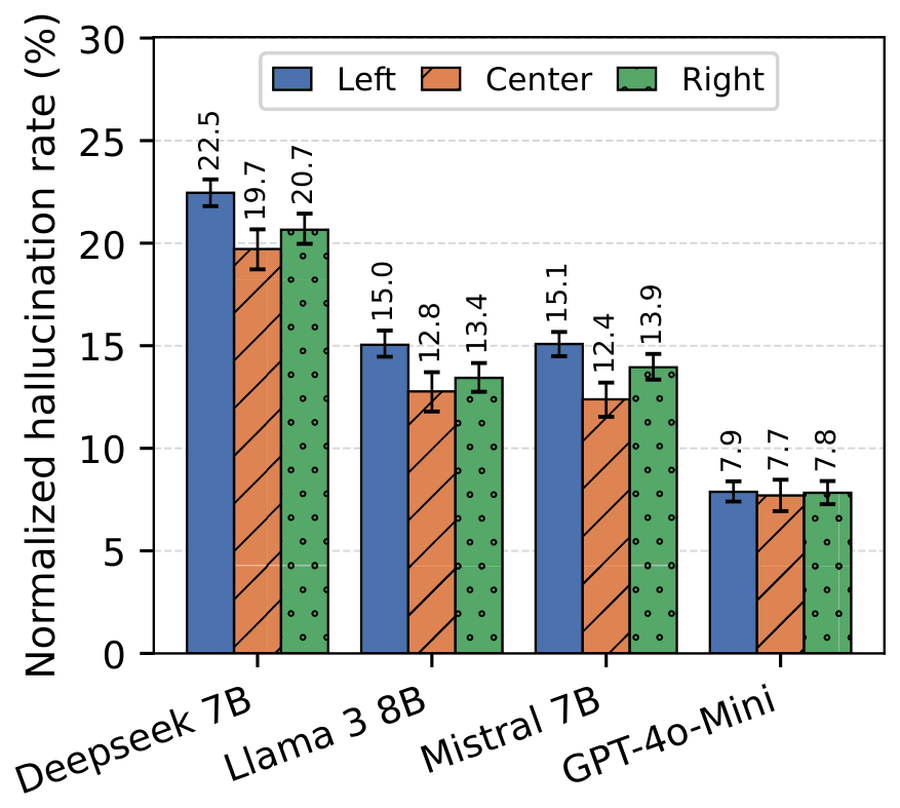
When language models answering from a news article add claims the article does not support, those claims lean left in every model tested, even when the article leans right.
Large language models (LLMs) are increasingly used to answer questions about political information, including in election-adjacent information settings where factual errors and ideological distortions are high-stakes. We present a reproducible measurement framework that treats hallucinations, unsupported statements in document-grounded QA, as diagnostic signals of ideological drift. Using 21,727 expert-labelled U.S. political news articles from QBias spanning left, centre, and right sources, we (i) generate an article-specific question, (ii) elicit document-grounded answers from LLMs, (iii) detect sentence-level hallucinations via reference-based comparison, (iv) classify the ideological valence of hallucinated sentences with a fine-tuned stance classifier, and (v) probe output logits to relate token-level uncertainty to hallucination and drift. Hallucination rates vary substantially across models and concentrate in contentious topics, while source-ideology differences in hallucination frequency are modest. In contrast, hallucination content exhibits robust leftward drift: a majority of hallucinated sentences are classified as left-leaning, including among hallucinations generated from right-leaning sources. Logit-level analysis shows hallucinations arise in high-entropy generation contexts, and in some models uncertainty also predicts leftward drift, consistent with an “uncertainty → guessing” mechanism. In advisory consultation with an election administration stakeholder, we discuss implications for auditing AI-mediated political information and for designing safeguards in election-relevant deployments.
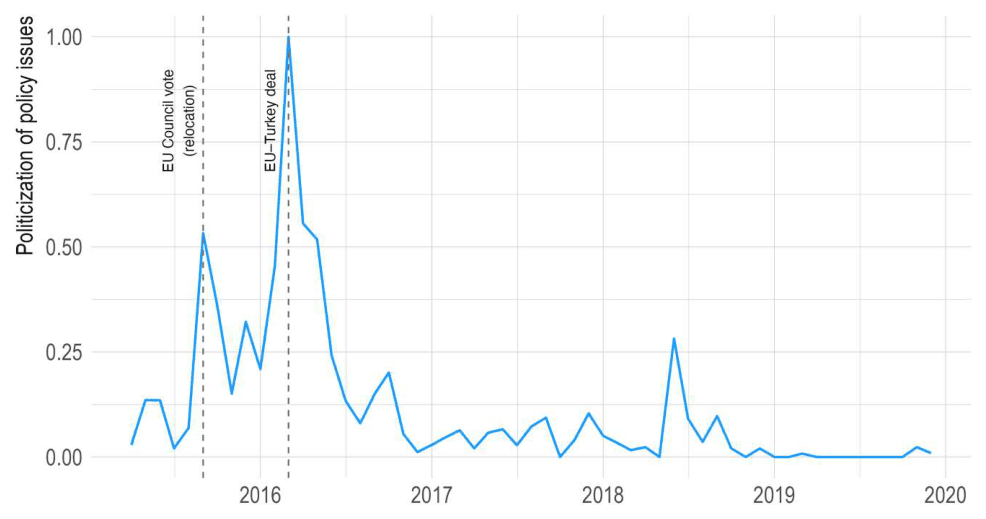
In the refugee crisis, asylum surges politicised EU decision-making only when public attention surged too, and politicisation faded without continued outside pressure.
The refugee crisis of 2015-2019 exposed deep tensions within the EU's compound polity, generating episodic bursts of political conflict and contestation over policy issues. This paper, drawing on punctuated politicization, conceptualizes politicization as an episodic feedback system linking three demand-side forces, namely problem pressure, public salience, and political pressure to the politicization of policy issues inside the EU's policy process, specifying the mechanisms that generate punctuated patterns observed in prior research. With an innovative dataset based on Policy Process Analysis (PPA), a Bayesian vector error-correction model traces both short-run shocks and long-run equilibria among the four variables. Results show that in the refugee crisis, public salience operates as a key enabling condition, as asylum surges politicize EU decision-making only when they trigger parallel surges in public attention; politicization itself cannot self-perpetuate, failing to affect public attention or asylum inflows absent continued external reinforcement; and political pressure activates countervailing forces, as gains for radical-right parties are followed by lower salience and fewer asylum applications, revealing a self-limiting feedback loop that drives the system back toward equilibrium.
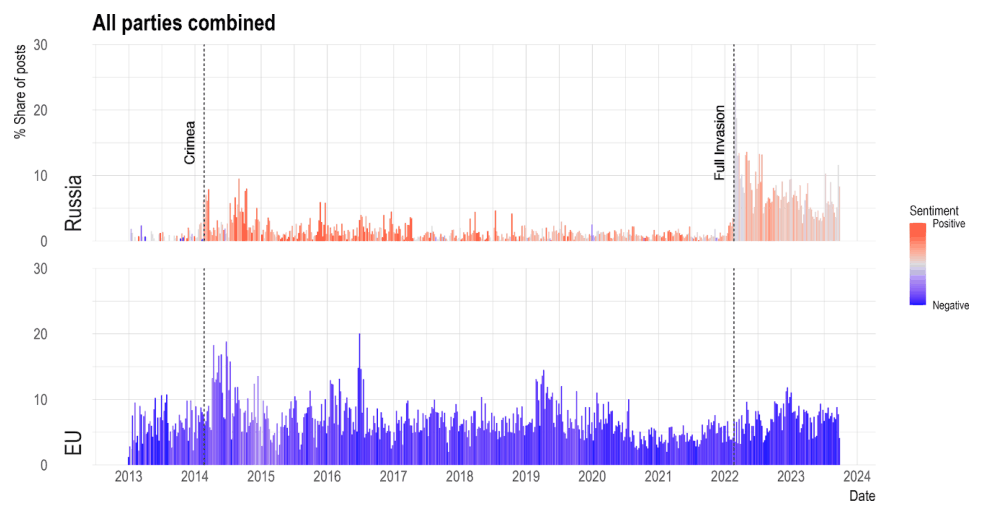
After the invasion of Ukraine, most radical-right parties close to Putin neither defended Russia nor changed position; they blurred the issue and attacked the EU.
The Ukrainian crisis has significantly shifted public opinion against Russia and Putin, placing politicians with prior Russian ties in a precarious situation. This paper tracks how parties that had some affinity to Putin have pivoted after the outbreak of war. Through computational text analysis of a decade of Facebook posts from eleven European radical right parties, we investigate their stance evolution towards Russia and their strategic management of public sentiment and Russian relationships. The results show that most radical right parties, after the invasion, neither tried to remain pro-Russia nor focused their attention on shifting their prior position. Instead, they engaged in blurring the issue, diverting attention away from the war and using the events in Ukraine to assert their anti-EU positions.
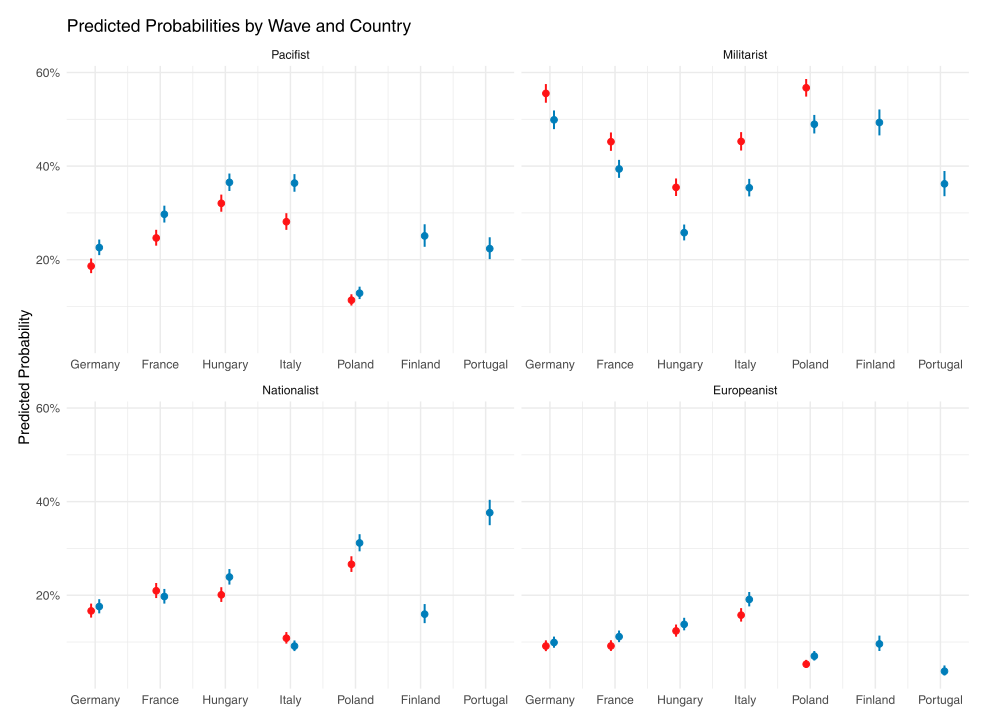
After Russia’s invasion of Ukraine, Europeans favour more military capacity nationally, in NATO and, to a lesser degree, at the EU level.
The Russian invasion of Ukraine has pushed the EU into a new phase where both the political elites and the public start to rethink its foreign and security policies. This paper uses a unique survey in seven European countries in the wake of the war to examine European public opinion on how the EU's foreign and security policies should be made and how autonomous they should be. We find that Europeans not only favour increasing military capacity at the national or NATO level but also prefer increasing military capacity at the EU level, though to a lesser degree. We also show that perceptions of both short-term and long-term threats, European identification and mainstream left-wing ideology lead Europeans to favour a more militarily powerful, unified and autonomous EU.
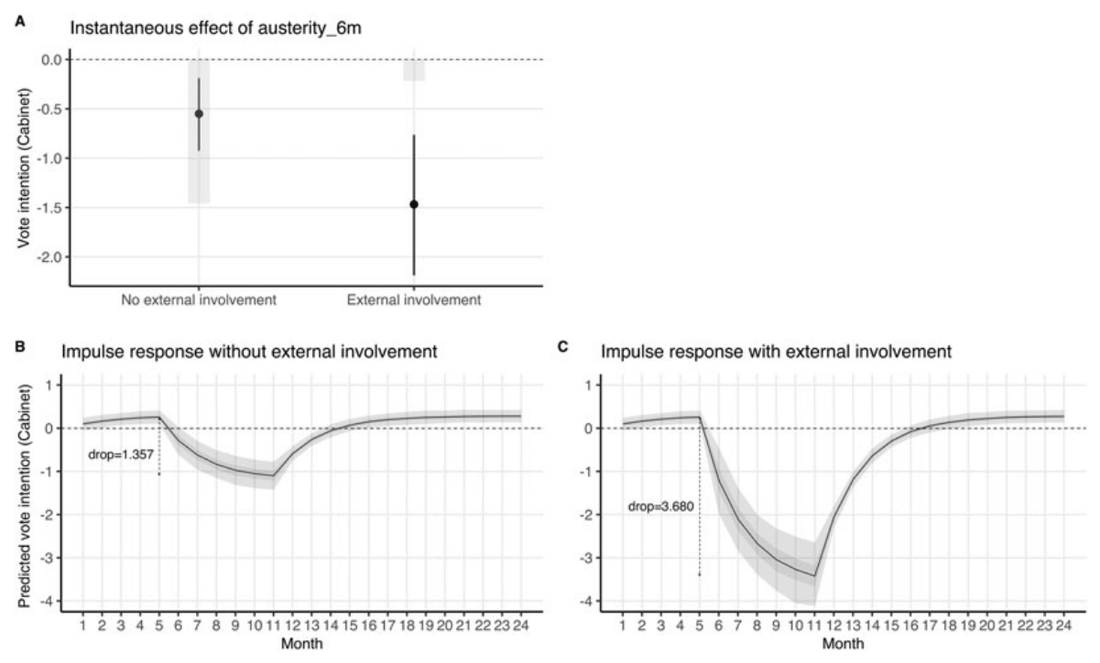
Austerity packages cost governments support in the polls, most of all when unemployment was rising, external creditors were involved and protest was intense.
During the Great Recession, governments across the continent implemented austerity policies. A large literature claims that such policies are surprisingly popular and have few electoral costs. This article revisits this question by studying the popularity of governments during the economic crisis. The authors assemble a pooled time-series data set for monthly support for ruling parties from fifteen European countries and treat austerity packages as intervention variables to the underlying popularity series. Using time-series analysis, this permits the careful tracking of the impact of austerity packages over time. The main empirical contributions are twofold. First, the study shows that, on average, austerity packages hurt incumbent parties in opinion polls. Secondly, it demonstrates that the magnitude of this electoral punishment is contingent on the economic and political context: in instances of rising unemployment, the involvement of external creditors and high protest intensity, the cumulative impact of austerity on government popularity becomes considerable.
Projects and grants
Navigating the Storm: European Political Contestation in Geopolitical Transformation (NEST)
Starter Grant, Dutch Ministry of Education, Culture and Science
Surveys and preregistered experiments in EU member states on how Europeans respond to geopolitical shifts, rearmament and the costs of common European policies.
€300,000Principal investigatorSince 2023
TRACE: Trustworthiness and Reliability Auditing of Conversational-AI for Elections
Network Institute Academy Project, Vrije Universiteit Amsterdam
Audits how reliably conversational AI answers voters’ questions about elections, following the White-Hat Testing framework with an open benchmark of election-information queries.
€30,000Co-principal investigator, with Jieying Chen2026
PoliBias: Political Bias in Language Models
Network Institute Academy Project, Vrije Universiteit Amsterdam
Benchmarks that measure the political leanings of language models, from how they vote on real parliamentary motions and roll calls to which way their errors lean in source-grounded question answering.
€30,000Co-principal investigator, with Jieying Chen2025
Quantitative Research and Methods in Political Science for undergraduates; Applying Quantitative Methods in Political Science, Political Science Research: Philosophy and Design, and the Workshop in Democracy, Power and Inequality for graduate students.
Bayesian statistics for social scientists: how it differs from the frequentist approach, simulation-based inference, and linear, count, hierarchical and measurement models.
Extracting and analysing quantitative information from text: web scraping, dictionaries, supervised and unsupervised learning, scaling, topic models, embeddings, transformers and LLMs.
Summer School in Social Science Methods, Lugano, since 2025
Diagnosing temporal dependence and modelling dynamic relationships: stationarity, autoregressive distributed lag and error-correction models, cointegration and fractional integration.